


'/%3E%3C/svg%3E)
 Home > Case studies > Technologie >
Micro-ondes vs radiofréquence : Comprendre la différence et choisir la bonne technologie
Micro-ondes et radiofréquence : exactement ce qu’il vous faut.
Si vous cherchez à améliorer votre procédé de chauffage, les technologies radiofréquence et micro-ondes peuvent être les meilleures solutions. Selon vos besoins, chacune de ces méthodes de chauffage offre des avantages significatifs. Voici quelques explications pour vous aider à comprendre leurs différences et les points forts de chaque technologie.
Les technologies micro-ondes et radiofréquence (RF) sont toutes deux des solutions efficaces, fiables et éprouvées pour les procédés thermiques industriels. Mais laquelle convient le mieux à votre procédé ? Comprendre les différences fondamentales entre ces deux technologies est essentiel pour faire le bon choix selon votre application.
Chez SAIREM, nous possédons une expertise approfondie des deux technologies, ce qui nous permet de fournir des recommandations adaptées aux caractéristiques spécifiques de votre produit et de votre procédé. Que votre objectif soit le chauffage, le séchage, le tempérage, la pasteurisation ou toute autre application, nous vous accompagnons vers la solution la plus performante et la plus efficace, avec un haut niveau de sécurité et de fiabilité.
 Spectre électromagnétique
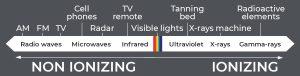
Comprendre le spectre électromagnétique
Les ondes électromagnétiques (EM) nous entourent en permanence — invisibles mais essentielles à nos communications, à la cuisson des aliments ou encore à certaines applications médicales. Le spectre électromagnétique est immense, allant des champs statiques à 0 Hz jusqu’aux rayonnements gamma dépassant 10²¹ Hz. Ces ondes peuvent être naturelles, comme la lumière du soleil, ou générées par des technologies développées par l’homme.
La partie radiofréquence du spectre électromagnétique s’étend de 100 kHz à 300 GHz et est utilisée dans de nombreux domaines :
- Communication : téléphones mobiles (700 MHz à 3 600 MHz), Wi-Fi, 5G, radio, télévision
- Applications médicales : IRM
- Applications thermiques : fours micro-ondes, procédés industriels
- Transfert d’énergie : recharge sans fil (chargeurs Qi)
Les micro-ondes industrielles, fonctionnant à des fréquences telles que 915 MHz ou 2,45 GHz, appartiennent à la même famille d’ondes électromagnétiques non ionisantes que le Wi-Fi ou les téléphones mobiles. Il s’agit d’une distinction importante : ces fréquences ne possèdent pas suffisamment d’énergie pour endommager l’ADN ou provoquer des mutations cellulaires.
Comment fonctionnent ces technologies
Au-delà de 100 kHz, l’effet principal des ondes électromagnétiques est thermique. Elles provoquent l’agitation rapide des molécules — notamment celles de l’eau — générant de la chaleur par friction moléculaire. C’est le même principe physique qui permet à un four micro-ondes domestique de chauffer efficacement les aliments, appliqué ici à l’échelle industrielle.
Le mécanisme de chauffage
Lorsque l’énergie radiofréquence ou micro-ondes est appliquée à un matériau :
- Les molécules polaires (principalement l’eau) cherchent à s’aligner avec le champ électromagnétique oscillant rapidement
- Cette réorientation permanente crée une friction moléculaire
- Cette friction génère de la chaleur directement à l’intérieur du produit, et non depuis sa surface
Ce principe de chauffage volumique distingue le chauffage électromagnétique des méthodes conventionnelles comme la convection ou la conduction, qui chauffent de l’extérieur vers l’intérieur.
Profondeur de pénétration : la différence clé
La différence essentielle entre les technologies micro-ondes et radiofréquence réside dans leur profondeur de pénétration et dans la capacité de l’énergie électromagnétique à pénétrer le produit :
- Radiofréquence (basses fréquences) : pénétration profonde, généralement de plusieurs dizaines de centimètres
- Micro-ondes (fréquences plus élevées) : pénétration plus faible, généralement de quelques centimètres
Chauffage micro-ondes vs radiofréquence : comprendre leurs effets grâce aux schémas ci-dessous
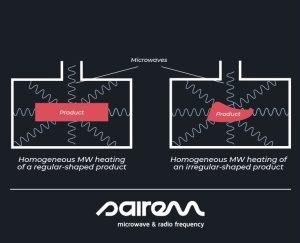
Les micro-ondes permettent un chauffage homogène des produits de formes irrégulières.
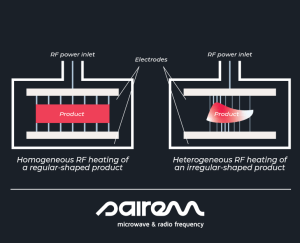
Des caractéristiques de chauffage adaptées à différentes applications
Les différences de pénétration entre les micro-ondes et la radiofréquence créent des profils de chauffage distincts, rendant chaque technologie plus adaptée à certaines applications.
Le chauffage micro-ondes est efficace pour des produits de toutes formes, permettant un traitement rapide et homogène même avec des géométries complexes.
Le chauffage radiofréquence convient davantage aux produits de formes régulières et de grandes dimensions, en assurant un chauffage volumique uniforme.
Applications typiques de la radiofréquence : blocs de viande congelée, blocs de poisson, grandes meules de fromage, mais aussi séchage du bois, traitement textile, …
Faire le bon choix entre les deux technologies (MO et RF)
Chez Sairem, nous ne croyons pas aux solutions universelles. Notre approche consiste à :
- analyser les caractéristiques de votre produit : forme, dimensions, composition, teneur en humidité, propriétés diélectriques
- comprendre les exigences de votre procédé : temps de traitement, températures cibles, cadence de production, contraintes qualité
- réaliser des essais dans nos centres de tests avec vos produits réels avant l’investissement industriel
- recommander la technologie optimale : micro-ondes, radiofréquence ou solution hybride
Parfois, le choix est évident. D’autres fois, les deux technologies peuvent fonctionner — et c’est là que notre expertise fait la différence pour identifier la solution la plus performante et rentable pour votre application.
Une énergie maîtrisée et fiable
Les ondes électromagnétiques font partie intégrante de notre quotidien : elles alimentent nos communications, l’imagerie médicale et de nombreux procédés industriels.
Aux fréquences utilisées dans les systèmes industriels micro-ondes et radiofréquence, les données scientifiques sont claires : l’exposition est sûre lorsqu’elle respecte les normes internationales. Les technologies micro-ondes et RF n’impliquent pas un risque lié aux radiations, mais une énergie contrôlée, fiable et performante au service des procédés industriels.
La vraie question n’est donc pas de savoir si ces technologies sont sûres, mais laquelle est la plus adaptée à votre application.
Le chauffage micro-ondes offre une grande polyvalence pour les produits de toutes formes, avec un traitement rapide et homogène même pour des géométries complexes.
Le chauffage radiofréquence excelle pour les produits de formes régulières, en assurant un chauffage volumique uniforme dans les grandes masses.
Chez SAIREM, nous vous accompagnons dans ce choix. Grâce à des décennies d’expérience, à nos capacités d’essais avancées et à notre compréhension approfondie des procédés industriels, nous vous aidons à sélectionner la solution offrant les meilleures performances, efficacité et sécurité pour votre application.
Prêt à identifier la technologie adaptée à vos besoins ?
Contactez notre équipe pour échanger sur votre application.