





Industrial food heating - Microwave and radio frequency systems | SAIREM Technologies
Microwave and radio frequency: efficient heating for modern food production
Microwave and radio frequency technologies are widely used in industrial food heating when speed and control are essential. They make it possible to bring products to temperature quickly, whether for heating, pre-heating or stabilizing a process.
Unlike steam or hot-air systems, where heat is applied from the outside, microwave and RF generate heat directly inside the product. The result is faster processing and a more controlled temperature rise. These technologies are particularly well suited for pumpable products such as sauces, soups and jams, but also for bakery items and semi-finished foods where consistency and repeatability are key.

Contact us to learn more about our microwave heating equipment
Key advantages of microwave and radio frequency heating

Rapid heating in minutes
Volumetric heating drastically reduces processing time, making microwave and radio frequency systems ideal for continuous industrial food heating lines.

Uniform and repeatable results
Consistent temperature distribution across the product mass eliminates cold spots and surface overheating.

Energy-efficient operation
Energy is transferred directly into the product, with efficiency levels up to 80%, reducing overall energy consumption.

Precise temperature control
Real-time control allows accurate heating, even for sensitive products requiring tight temperature ranges.
Food heating applications and products
Microwave heating is widely used for the efficient and uniform processing of a wide range of food products, from liquid and pumpable products to solid and semi-finished foods.
Biscuits heating
Microwave and RF systems are commonly used for biscuit heating prior to further processing such as molding, enrobing, or cutting.
- Uniform heating without damaging fragile textures
- Reduced breakage rates during shaping
- Fast processing for high-throughput biscuit lines

Soups heating
Microwave food heating systems provide fast and uniform heating of soups, including products with particulates.
- No scorching or surface overheating
- Perfectly controlled viscosity
- Reduced energy consumption
- Compatible with continuous production

Sauces heating
From tomato sauces to thick emulsions, microwave heating ensures clean, efficient temperature rise without altering texture.
- Uniform heating in viscous or particle-rich products
- Stable emulsions maintained
- Rapid line changeovers
- No risk of burning-on

Jams heating
Microwave heating preserves fruit integrity while achieving rapid thermal transfer.
- Maintains color, flavor and fruit piece structure
- Fast and precise temperature control
- No caramelization or sticking
- Clean-label compatible
Here’s a questions-and-answers section about our food heating solutions.
Industrial microwave food heating systems can process liquids, semi-liquids and viscous products such as soups, sauces and jams, as well as bakery products and prepared meals.
Yes. Microwave and radio frequency heating technologies are non-ionizing and widely used in industrial food heating. Systems are fully shielded and comply with international safety standards.
Microwave and RF systems generate heat directly inside the product, making them significantly faster than conventional conductive heating methods while improving temperature uniformity.
Do you need help improving your food production process?
Our experts are here to assist you in finding the best solution!
Case studies

Industrial bakery market in transformation
Discover SAIREM industrial microwave solutions for bakeries and pastries: butter tempering, dough defrosting, pasteurization and more.
Learn more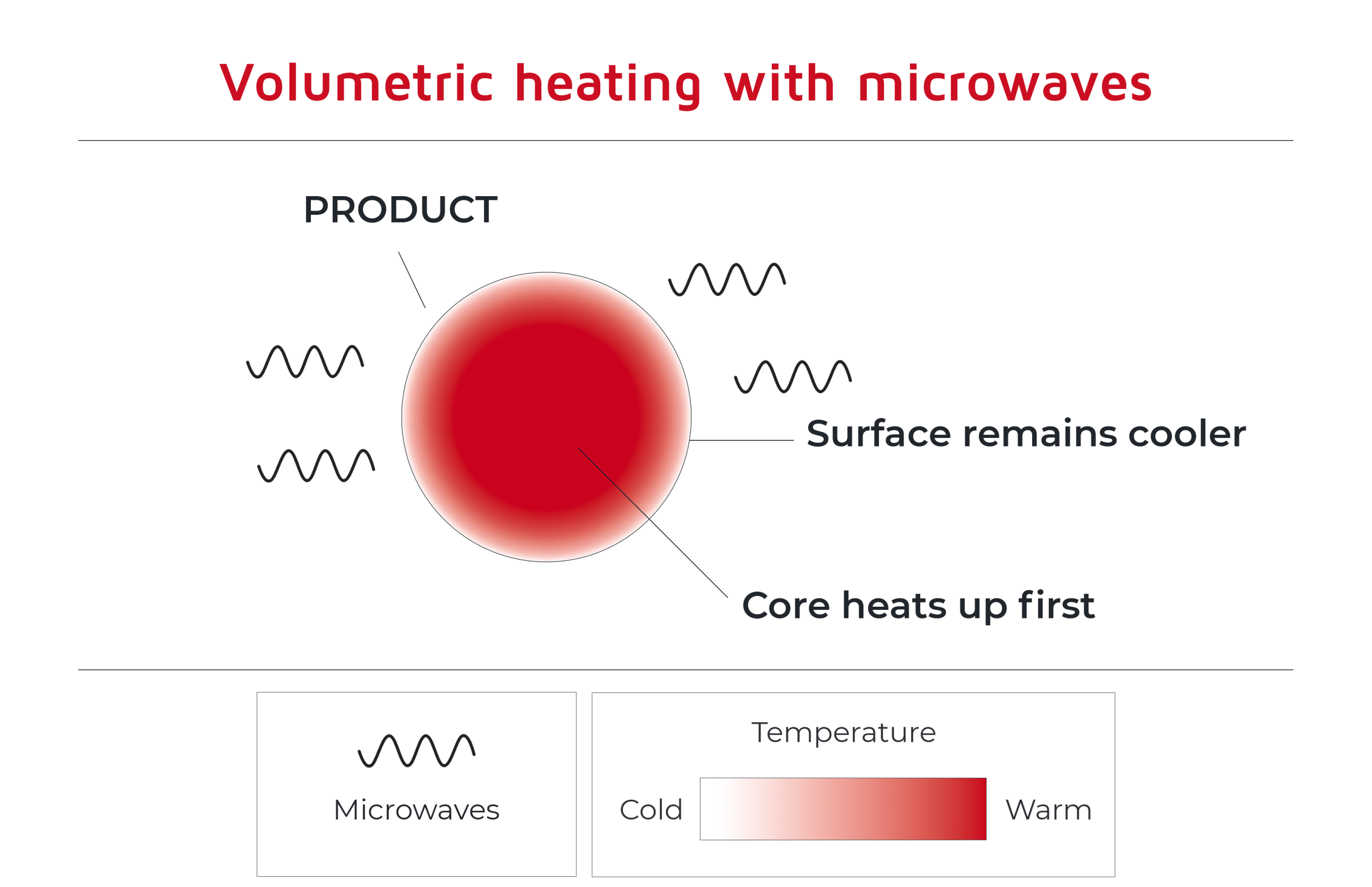
Volumetric heating: fast and uniform energy transfer
Volumetric heating uses microwave energy to generate heat directly inside the product, enabling faster, more uniform and energy-efficient industrial processing.
Learn more