

 > Case studies >
What are the different food defrosting, tempering or thawing technologies and processes?
Before processing or cooking, most frozen foods need to be thawed in order to obtain a suitable result. Here are the most common defrosting methods and their advantages and drawbacks …
Cold room thawing
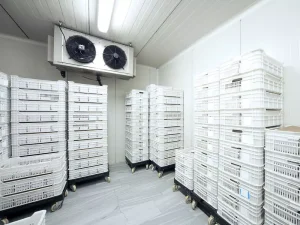
Thawing in a cold room is one of the most common methods. Frozen food is stored in a room at a temperature around 5 ° C with air circulation, until it slowly reaches room temperature.
However, this simple solution has several drawbacks: the defrosting time can last up to 48 hours, the result is not always homogeneous, but above all significant food drip losses occur.
Cold water thawing
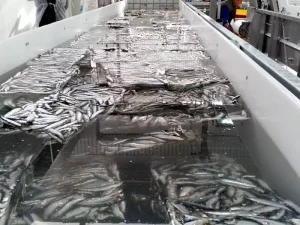
This method is faster than defrosting in a cold room, but requires more care. Food should be in an airtight package or plastic bag. If the bag leaks, bacteria in the water can contaminate the food. In addition, the meat tissue can absorb water resulting in a watery product.
Relatively efficient for defrosting whole fish, this method is not well suited for other foods.
Tumbling thawing
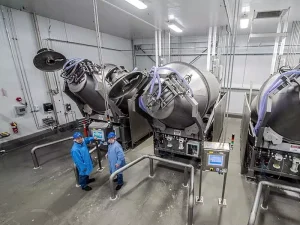
Tumbling thawing involves a rotating drum whose walls are slightly heated. On some cases, cold steam under vacuum is added to improve the process. This solution is faster than cold room defrosting as it takes hours instead of days.
But this process is not continuous, which is not really suitable for processing of large amount of food and not adapted at all for delicate products like fruits and vegetables.
Open air thawing
Although still used in some places, open air thawing is prohibited in many countries. This is because this method is faster than thawing in a cold room, but the surface of the food can reach temperatures where bacteria grow rapidly, making the food unsafe for consumption, even after cooking.
In addition, significant driploss occur with this solution. It is therefore a method to be totally avoided.
Microwave thawing
The microwave and radio frequency have the property to thaw the entire mass of a product quickly and homogeneously. Unlike other solutions, where heat is transferred by conduction from the surface of the food to its core, the waves goes through the entire food block. The speed of the process prevents drip-loss or bacterial growth.
The defrosting by microwave or radio frequency takes from 3 to 20 minutes instead of hours or days with traditional methods, even for large food blocks. This technology is adapted even for sensitive products like fruits and vegetables.
NUTRITEMP RANGE
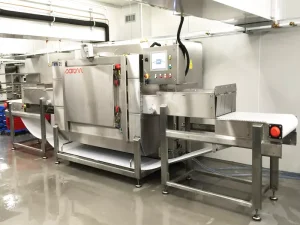
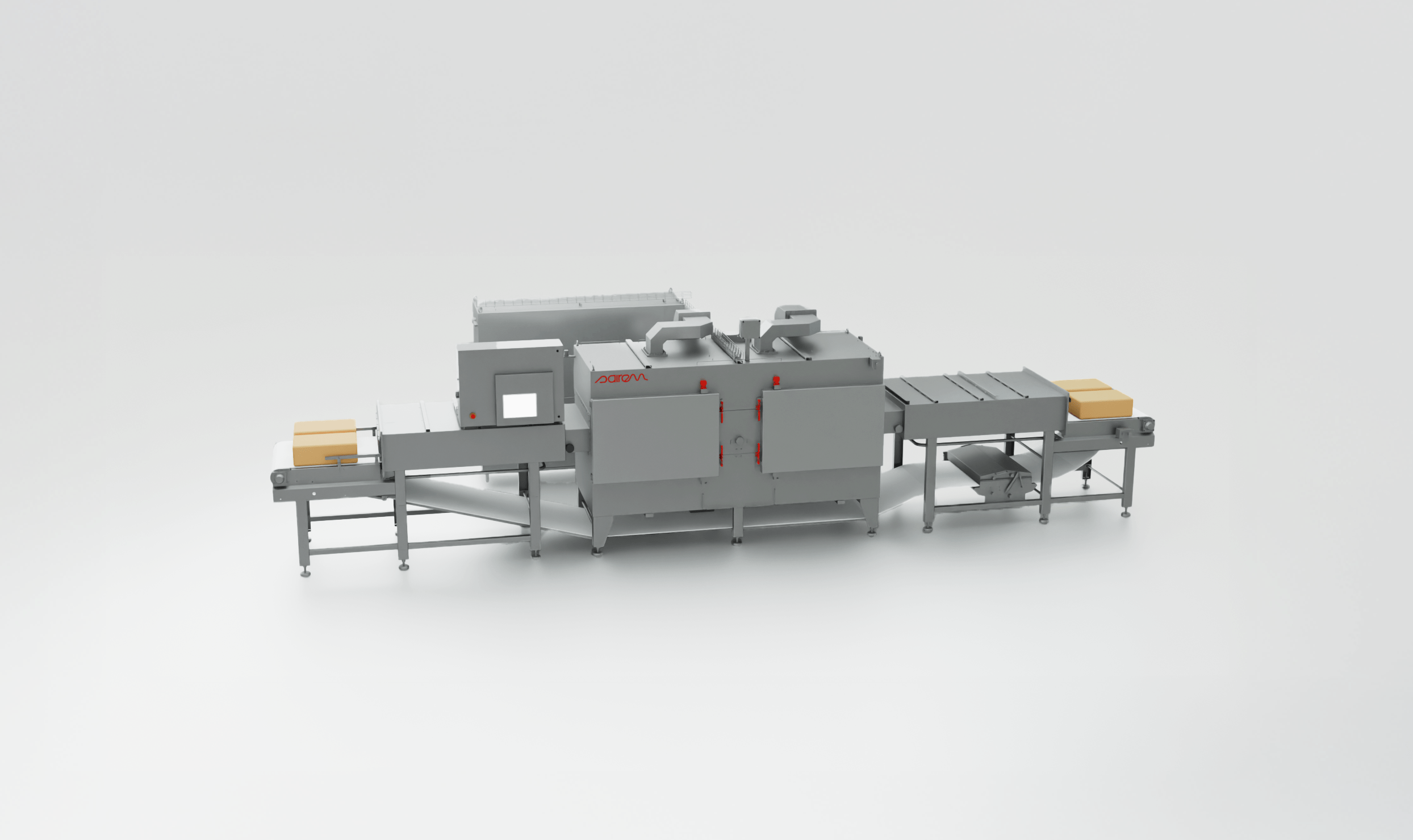
Our microwave and radio frequency tempering and defrosting solutions are designed for industrial food processing applications requiring fast, controlled, and uniform tempering and thawing. They support both packaged and unpackaged products, ensuring precise temperature control prior to further processing.
Available in batch, compact, and modular designs, our space-saving tempering and defrosting equipment adapts to different production volumes, site constraints, and product types. With remote control connectivity for monitoring and process optimization, our systems deliver consistent product quality, reduced lead time, and stable, efficient production flow across a wide range of operating conditions.
Calculate your payback
How much is drip loss really costing you?
Every thawing cycle comes with hidden losses. Depending on your product and process, drip loss can reach up to 8% of total weight — directly impacting your margins before production even begins.
With just a few inputs, you can estimate your actual financial losses and identify how much you could recover with a more efficient defrosting solution.

Test our food processing solutions
Interested in testing industrial microwave or radio frequency technology to optimize your food processing performance?