



 > Case studies >
Are microwave and radio frequency technologies safe for industrial use?
Understanding electromagnetic waves and their effects
Electromagnetic waves are part of everyday life. We rely on them constantly: to communicate, to cook, even in medical applications, although we rarely notice them.
Their spectrum is extremely wide. At one end, there are static fields at 0 Hz. At the other, gamma radiation can exceed 10²¹ Hz. Some of these waves occur naturally, like sunlight. Others come from the technologies we use every day.
Microwaves, radio frequency and Wi-Fi: the same spectrum

In mobile communications, frequencies typically range from 700 MHz to 3,600 MHz. Industrial microwave systems, operating at 915 MHz or 2.45 GHz, sit in that same range.
They belong to what is known as non-ionizing electromagnetic radiation. In practical terms, this means they do not carry enough energy to damage DNA or cause cellular mutations.
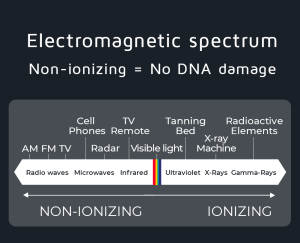 The radiofrequency (RF) spectrum, from 100 kHz to 300 GHz, is used across many fields: telecommunications (Wi-Fi, mobile networks, 5G), medical imaging such as MRI, heating systems, and even wireless power transfer like Qi chargers.
Above 100 kHz, the effect of these waves is essentially thermal. They cause molecules, especially water, to move and vibrate. That movement generates heat.
A well-understood thermal effect
Unlike ionizing radiation such as X-rays or gamma rays, RF waves cannot break molecular bonds or alter DNA. This point is well established.
Decades of research show that, below 300 GHz, the only confirmed effect of electromagnetic exposure is heating of tissues.
Despite common misconceptions, microwave and RF systems do not expose products or operators to harmful radiation.
Because the effect is purely thermal, it can be accurately measured, monitored, and controlled, which is why microwave and radio frequency technologies are widely used in regulated environments such as food processing and medical applications.
Where the limits are: understanding exposure
RF fields can penetrate the body. The penetration depth varies with frequency — the higher the frequency, the more superficial the effect.
At typical exposure levels, the temperature rise remains minimal. The body regulates it naturally, in the same way it does during physical activity.
Problems only appear beyond a certain threshold, when exposure is strong or long enough to create excessive heating. In those cases, effects such as heat stress or burns may occur.
Below that threshold, no adverse health effects have been consistently demonstrated.
Numerous studies have looked at potential links with headaches, sleep quality, concentration, cardiovascular effects, or cognitive performance. The results remain inconclusive.
The only reproducible observation is a slight change in brain activity measured by EEG, with no demonstrated biological or clinical impact.
Regulation and safety standards
The scientific consensus is clear: exposure to radio frequency electromagnetic fields below the thermal threshold does not lead to proven adverse effects.
International bodies such as the International Commission on Non-Ionizing Radiation Protection define exposure limits based on this research. These guidelines were updated in 2020 to reflect the latest data, including the deployment of 5G technologies.
In Europe, the Directive 2013/35/EU regulates occupational exposure. It aligns with ICNIRP recommendations and ensures that industrial systems — including those operating at 915 MHz and 2.45 GHz — remain well below safety limits.
To conclude, are microwave and radio frequency safe?
Electromagnetic waves are deeply embedded in modern life, from communication networks to medical imaging and industrial processing.
At the frequencies used for microwave and radio frequency technologies, the mechanism is simple: controlled heating.
When systems are properly designed and operated within established limits, the science is clear — the process is safe.
Let’s improve your industrial process performance
Our experts are here to assist you in finding the best solution.