

 > Case studies >
Volumetric heating: fast and uniform energy transfer
A different way to generate heat inside the product
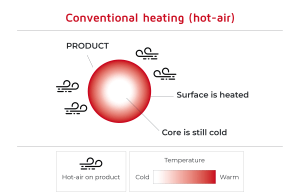
Traditional heating methods rely on heat transfer from the outside to the inside. Convection, conduction, or radiation first heat the surface, and only then does the temperature slowly diffuse toward the core. This takes time. It also creates temperature gradients that are often difficult to control.
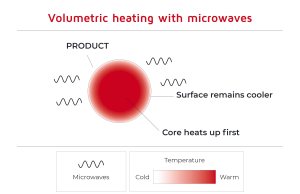
Volumetric heating works differently. With microwave and radio frequency technologies, energy is generated directly within the product. The whole volume heats up at the same time — not just the surface.
The result is a faster, more uniform, and more controlled temperature rise, even in dense, viscous, or heterogeneous materials.
How volumetric heating works
This process is based on the interaction between electromagnetic fields and the material’s dielectric properties. In simple terms, polar molecules — mainly water — respond to the alternating electromagnetic field by oscillating rapidly.
That movement creates internal friction. And that friction generates heat.
Unlike conventional systems, there is no need to transfer heat from an external source. Energy is delivered directly into the product, where it is needed.
Why it changes industrial processing
Because heat is generated throughout the product, volumetric heating removes many of the limitations of conventional thermal processes.
There is no slow diffusion step. No overheating of the surface while waiting for the core to reach temperature. The process becomes faster, more predictable, and easier to control.
This is particularly valuable for products that are sensitive to temperature, or difficult to heat evenly — such as viscous fluids, powders, or multi-phase foods.
Fast temperature rise
Energy is generated directly inside the product, reducing processing time from minutes to seconds in many applications.
Uniform heating
No surface overheating or cold spots. The entire product reaches temperature more evenly, even in complex or dense materials.
Energy efficiency
Energy is transferred directly to the product, not lost in heating air, walls, or equipment. This results in high overall efficiency.
Process control and repeatability
Heating is precise and easy to control, ensuring consistent results from batch to batch and across continuous production lines.
A controlled and measurable thermal effect
Volumetric heating is often misunderstood, but its mechanism is well known. It is purely thermal.
Electromagnetic waves in the microwave and RF range do not alter molecular structure or chemistry beyond heating. They simply generate heat through molecular motion.
This makes the process predictable. Temperature can be measured, controlled, and validated — which is why it is widely used in regulated industrial environments.
Adapting the technology to the product
Not all products behave the same way under electromagnetic fields. Penetration depth, heating rate, and uniformity depend on frequency, composition, and geometry.
Radio frequency allows deeper penetration, making it suitable for thicker or bulk products. Microwave offers faster heating and is often used for more compact or continuous applications.
Choosing the right configuration is key to achieving optimal performance.
Applications across industries
Volumetric heating is used in a wide range of industrial processes:
Let’s improve your industrial process performance
Our experts are here to assist you in finding the best solution.